Author Archives: Leith Central Community Council

National body pushes local activism

Community Councils get a mention in the bi-weekly online newsletter for the Scottish Community Alliance (SCA) , a national body which promotes the work of local people in their communities.  SCA campaigns actively at policy level for more effective local democracy.
The Alliance says that the body came into being to provide a ‘gathering point’ where organisations and individuals who support community empowerment can join forces.  The charity praises what it calls the scale and diversity of local activity  and says that it creates the ‘social glue’ that binds a community together and generates the civic pride that people feel for the place they live.  You can read more about the Scottish Community Alliance on the website at http://www.localpeopleleading.co.uk/
In December 2011 the Alliance published an article by Leith community councillor, Jenny MacKenzie and also carried a link to a recent Radio Scotland audio by the same author.  Calling the article Life in Community Councils Yet, the Alliance said:
“In the last Briefing we carried a story suggesting that Scotland’s community councils were in need of radical overhaul. While the national umbrella body seems locked in a dispute with Scottish Government over its funding and has taken the decision to shut up shop rather than work within a reduced budget, there are clearly many more who believe passionately in what they do and are keen to engage in a national debate about the future. ” To read more go to Life in Community Councils yet 

Houses planned for factory site

Plans for new housing in the Bonnington area of Leith were discussed and debated  at the November meeting of Leith Central Community Council (LCCC).

Architects Fouin andBell, acting for Hillside Housing Association (HHA), presented the proposal with a member of estate management company P2 Partnership (Bonnington) Ltd for land betweenSouth Fort Street/West Bowling Green StreetandGraham Street.

Principal landowners for the site are the fourth-generation family business and engineering firm Blake Group, which specialises in multi-disciplinary steel fabrications and tank manufacturing. The 70-year-old factory on the site is no longer fit for purpose and the company now intend to relocate outside Edinburgh. In 2006 Blakes engaged with the City of Edinburghto produce a Development Brief for the Bonnington area (BDB). This meant that sites which were originally industrial could now be designated for residential housing with some industrial units.

With one goal being to provide affordable rented housing for key workers in the area, the proposed scheme includes a mix of rental tenures, with a variety of sizes from studio through to three-bedroom family flats. Some rents would be mainstream, almost 150 mid- market, and more than 30 flats providing affordable rents.  The accommodation would be managed by HHA.

The developers told the meeting that an application will be made in December 2011 for Phase 1A of the project, which is for 49 flats; the early timescale being necessary to obtain Housing Association Grant Funding.

Community Council members had concerns about this timescale and fears that demolition would occur before funding was in place. It was also felt that that the proposed development, which was purely residential, ignored the BDB; however, it was claimed that a possible future second phase, including land south of the present application (some of which was owned by Blakes) would include some commercial units.

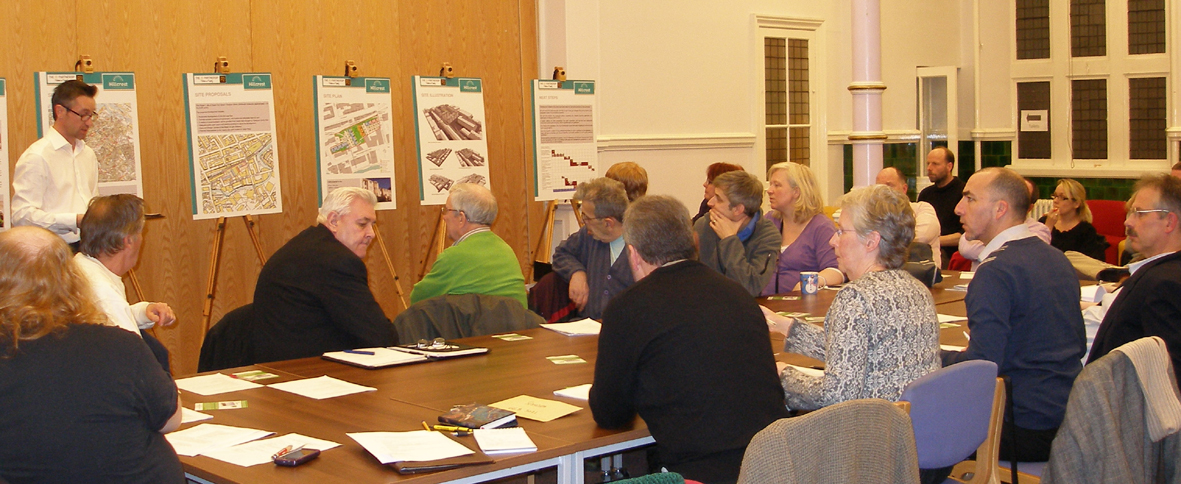
Two evening exhibitions of this scheme at the pre-planning stage had been held, with more than 50 people attending. Several neighbours of the proposed scheme, residents ofPitt Street, expressed concerns about overshadowing and loss of daylight. The developers said that the development had been prepared in accordance with strict technical standards and had met all requirements.

One objector suggested that a 3D model should be provided to enable a clearer understanding of the building heights.  A further objection was that the blocks were too homogenized in design, with little scope for visionary architecture.